Imagine the car has just been invented, and an investor gives a startup this requirement:
“Your car must directly replace a horse, travel across any terrain, and cost less per trip than a horse.”
No building roads. No building gas stations. No redesigning the transportation network.
It sounds absurd. Yet many business models for enterprise agents today follow a similar logic: one procurement agent replaces one procurement position, one sales agent replaces one sales position, and then the company tries to prove that the agent costs less than a person.
The car has to prove its economic viability by being used like a horse; the agent has to prove its economic viability by doing the work of an existing job.
But the value of a car is not just that an engine replaces a horse. Cars need roads, traffic rules, energy supplies, and repair networks. They also gave rise to new forms of transportation and logistics.
Cars changed transportation capacity and drove a reorganization of infrastructure, the division of work, and collaboration.
Is AI facing the same problem?
1. New productive forces do more than replace old tools of production
Designing an agent around a job is a natural product idea. Companies already pay people to do these jobs. If an agent can do the same work at lower cost, its economic value is easy to explain.
But that reasoning assumes one thing: the work performed by existing jobs should still be organized and completed in the same way.
A job is not a basic unit that exists naturally in the business. It is a combination of functions and responsibilities that an organization arranges under particular conditions of production.
For example, one procurement specialist may verify demand, request supplier quotes, execute orders, track delivery dates, and coordinate exceptions. Some of this work comes from the business itself; some exists to compensate for current information conditions and organizational arrangements.
If orders, materials, suppliers, and delivery requirements are not reliably connected, the procurement specialist has to keep checking spreadsheets, asking people, and reconciling status.
Designing an agent to do everything covered by this job requires business judgment, cross-system operations, information retrieval, and extensive communication and coordination. We then keep strengthening harnesses, memory, context, and tool-calling mechanisms in the hope that the agent can adapt to the existing environment.
That is like demanding an all-terrain vehicle that can drive through any mud.
But if we change the business environment so the system can reliably maintain object relationships, rules, and current states, some work no longer needs to be repeated. The remaining functions can then be redistributed among people, AI, and digital systems.
New productive forces may replace the people carrying out an old division of work, but they may also change the division itself.
2. Reorganizing production starts with understanding the business
New ways of dividing work cannot be designed out of thin air.
What role does the company play in its value chain? What business activities must it perform? What resources, rules, and collaboration do they depend on? Only by answering these questions can we judge which work can be automated, which functions can be recombined, and which tasks can be eliminated.
This is the dependency described in “Why enterprise AI must start with the business”:
Business → organization → systems → agents.
The business defines what needs to be done. The organization assigns responsibility. Systems support business objects and operating rules. Agents can then act within that environment.
But this chain does not mean the existing organizational structure must remain unchanged.
In the past, companies coordinated complex work through departmental divisions, approval workflows, and layers of reporting. These arrangements also created substantial costs for passing information, checking states, and communicating.
When business objects, relationships, rules, and states can be shared, some coordination work may become a system capability. Functions that once belonged to different departments can be recombined, with corresponding changes to responsibilities and management practices.
AI does not mean that departments must disappear. New risks and governance requirements may create new functions as well.
The key is that organizational structures should be designed around business needs and new conditions of production, rather than treated as fixed boundaries for new productive forces.
3. What kind of operating environment does an AI-native organization need?
The difference between an AI-native organization and a traditional company adopting AI should not be reduced to how many agents they use.
One company may deploy many agents while continuing to organize work around its existing departments, jobs, and system boundaries. Each agent improves a local task, but end-to-end business still requires repeated handoffs across systems and departments.
Another company may use only a few agents but start from the business and redesign its functions, responsibilities, and ways of working together.
The point of an AI-native organization is not to install AI inside an old organization, but to design the organization around new intelligent capabilities.
That design needs a supporting operating environment.
If business objects are scattered across systems, rules are buried in documents and people’s heads, and states are synchronized manually, people and AI will still struggle to collaborate reliably even after functions have been reassigned.
One promising direction for AI-native systems is to establish business objects, relationships, rules, states, and responsibilities as a shared foundation, so different participants can keep understanding and changing the same business world.
Semantic layers and knowledge graphs often focus on concepts, data definitions, and relationships between objects. They may not explicitly model organizational functions and accountability: who is responsible for what, who has decision-making and action authority, and how tasks are handed off. Business structure alone is not enough; the organization’s operating structure also needs to be represented.
Palantir’s Ontology has attempted to connect data, logic, and action to business objects. But having action interfaces does not automatically define organizational responsibilities. Making a model carry through to actual execution, and allowing multiple agents to continue the same business activity, still need to be solved.
This is both a technical and an organizational question: Who is responsible for business definitions? Who maintains shared rules? Who has the authority to adjust system boundaries and the division of responsibilities?
Traditional companies have accumulated business knowledge, but may be constrained by organizational inertia and existing systems. Newly established AI-native companies have more room to design, but still need to build real business capabilities.
The real difference is whether an organization has the ability and authority to keep defining the business, adjusting the division of work, and changing its operating environment.
If an organization can only add agents but cannot change their environment, agents will continue to bear the complexity left unresolved upstream. This is also the question explored in “Why do AI agents stall when put to work?”: while everyone is busy building more capable all-terrain vehicles, should we also consider building roads?
4. How should we measure the value created by new productive forces?
Imagine that each of the following uses the same 100 liters of fuel:
- Someone transports 100 tons of cargo along a highway.
- Someone struggles through mud for half a day before reaching the destination.
- Someone spins their wheels in place and gets nowhere.
- Someone builds a road so that every vehicle can travel smoothly in the future.
Similarly, the same amount of token usage may represent completing a task efficiently, repeatedly restoring context, retrying without progress, or investing in business modeling, durable rules, and a better operating environment.
Fuel consumption is not transportation efficiency, and token usage is not AI productivity.
More importantly, building a road does more than lower transportation costs. Excavators and road rollers may consume more fuel than cars, but roads not only make existing transportation more efficient; they also make previously hard-to-reach places accessible, enabling supply delivery, public services, and emergency response.
Even with little traffic, a road can greatly improve connectivity and governance across an entire region.
Enterprise digitalization works the same way. Making business objects, states, rules, and responsibilities explicit may reduce repeated reasoning and manual coordination. It can also help organizations see business activity that was previously invisible, trace problems they could not previously locate, and coordinate resources that were once difficult to organize.
This is the central idea in “The essence of digitalization is improving the governance capacity of complex systems”: cost reduction and efficiency gains are only part of the result. More fundamentally, organizations gain the ability to govern complexity they could not govern before.
We should therefore evaluate AI not only by the return on investment of an individual agent, but also by the efficiency, quality, risk controls, and governance capacity of the business system as a whole—and by the new space for value creation these capabilities open up.
Here is a proposition worth testing:
The value created by new productive forces may not be fully measurable within the boundaries set by existing relations of production.
If we evaluate a highway only by the return from a single trip, we miss the economic and social value created by the transportation network. If we evaluate AI only by the cost of replacing jobs, we may miss the benefits of redesigning organizational roles, building a shared environment, and increasing governance capacity.
New productive forces may not only make existing work more efficient; they may also change what we can accomplish and the scale and ways in which we can organize production.
5. From Enterprise OS to Industry OS: the division of work can extend beyond the company
If AI can change jobs, functions, and departmental divisions within a company, it may also change the division of work between companies.
The boundaries of a firm are also shaped by productive capabilities, transaction costs, and the conditions for collaboration.
In the past, a function may have needed to stay within a company because external collaboration was too costly. Different companies may have maintained the same business rules because they lacked a shared digital foundation. Upstream and downstream partners may have relied on documents and manual communication because they could not continuously share trusted business states.
When these conditions change, the existing division of work can be redesigned.
For example, could recurring cross-company work such as validating product information, matching supply and demand, and tracking delivery become shared industry capabilities? Could people and agents from different companies collaborate continuously around common business objects, rules, and states?
That requires resolving data permissions, accountability, commercial interests, and trust—not just connecting a few APIs.
An Enterprise OS can be seen as an exploration of a shared business environment within a company. Extending reusable industry definitions, rules, and collaboration capabilities across companies could lead toward an Industry OS.
Its potential value is not only reducing duplicated effort; it may also provide a foundation for new divisions of work across an industry.
This path does not have to begin with a complete platform. It can expand from small, real business loops, allowing validated structures and capabilities to be reused by more participants.
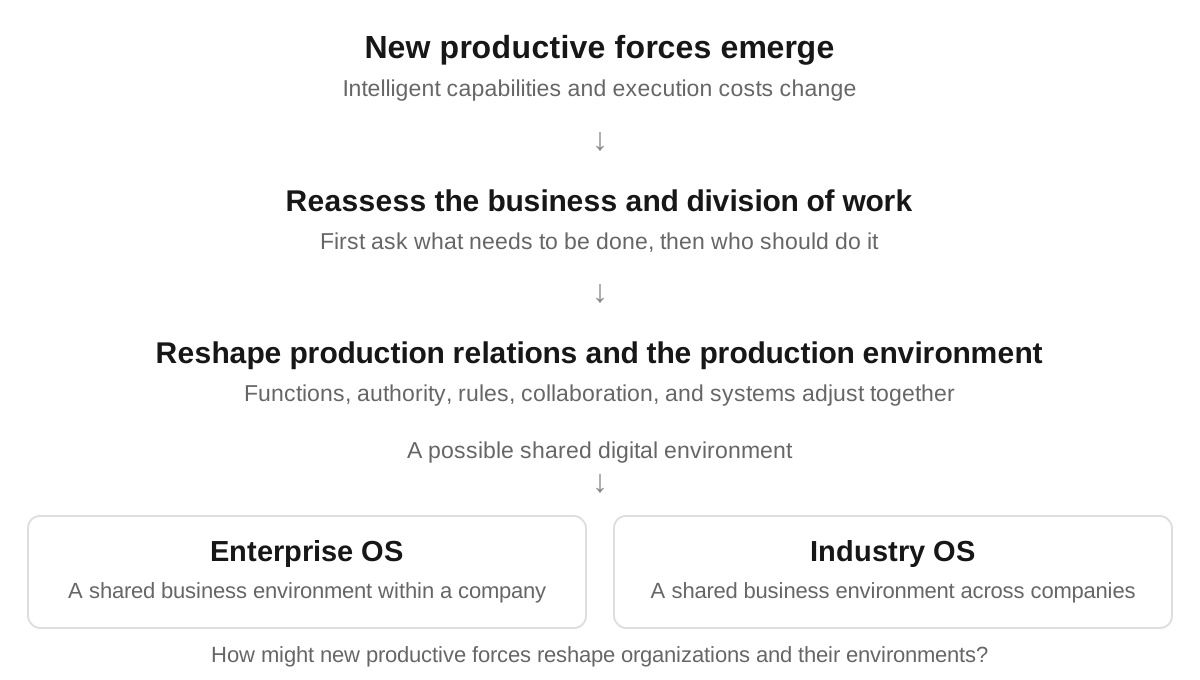
Conclusion | From replacing horses to rebuilding the transportation network
Imagine a company that no longer relies mainly on people watching systems and group chats to keep work moving.
A customer posts a delivery-date change in a group chat. An agent recognizes the request and links it to the relevant order and delivery item. The system identifies affected materials, production plans, and supplier commitments. AI evaluates feasible options. The system automatically handles what falls within established rules, while a person with the authority to decide handles any change to a commercial commitment.
Once a decision is made, the task is assigned to the right person or agent, and the execution result continuously updates the business state. The next participant does not have to ask for the background or reconcile the data all over again.
As this capability develops, some information transfer, repeated checking, and workflow coordination may disappear. Functions once fixed within particular jobs can be recombined, and smaller teams may be able to manage more complex businesses.
As collaboration extends to upstream and downstream companies, tasks once scattered across organizations may continue through a shared business environment. Companies can focus more on their areas of strength and use shared capabilities to participate in more complex industry networks.
This could give rise to a new form of organization: people and AI dynamically divide work around business goals; organizations keep adjusting to the needs of production; and shared digital environments take on more of the work of connecting and coordinating.
These changes still need to be tested in real businesses, but they point to a path for developing productive forces that goes beyond job replacement.
Cars did more than replace horses. They transformed how people move, produce, and live.
Unlocking AI’s productive potential may mean more than letting companies do the same work with fewer people. It may let us take on tasks that were previously too difficult, build forms of collaboration that could not previously be sustained, and enable more people and intelligent systems to create value together.